"Lincoln said you could never fail as long as you never stopped trying."
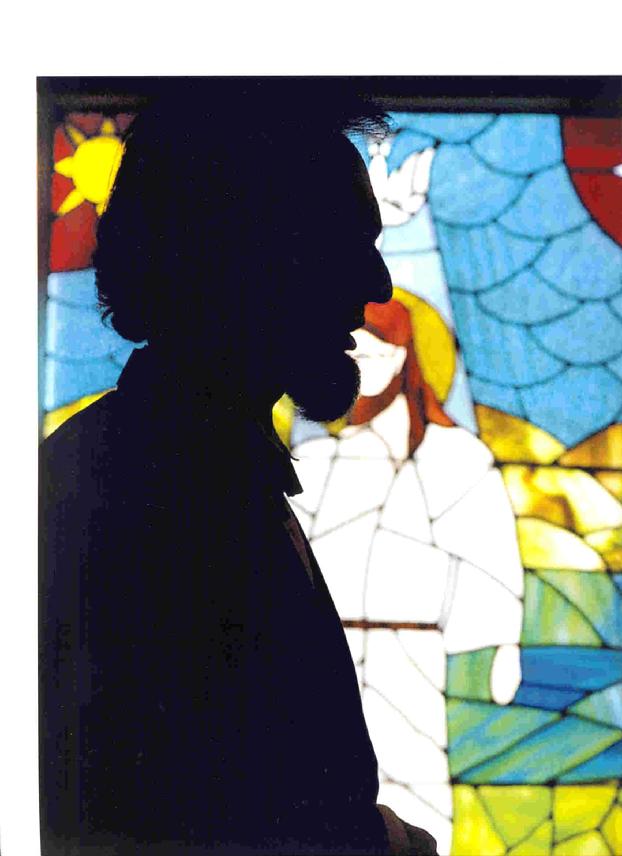
Nashville actor, Dennis Boggs stands in front of the stained glass window at First Baptist Church in Destin on Wednesday. Boggs portrayed President Abraham Lincoln to students at First Baptist Academy, and at other public schools and library branches this week.
Honestly, Abe Comes Alive for Area Students
Lincoln Presenter, Dennis Boggs visits First Baptist
Academy to impart some presidential wisdom.
by Kari Barlow
The one-man show "Meet Mr. Lincoln", starring Nashville actor Dennis Boggs, was performed for more than 100 elementary and middle school students. The program, sponsored by the Okaloosa County Library Cooperative, was performed at several public schools and library branches this week.
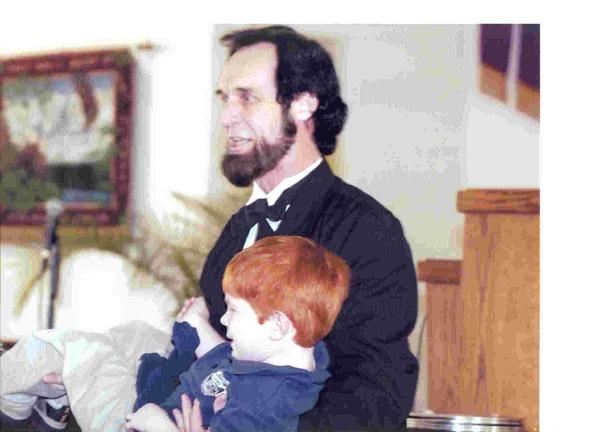
Abraham Lincoln Presenter, Dennis Boggs hold First Baptist Academy student, describing how the president once helped his stepbrother make footprints on the freshly painted walls of his family cabin as a child.
DESTIN - "Keep your promises. Stay in school. Ready every book you can get your hands on." Such was the advice of President Abraham Lincoln, who dropped by First Baptist Academy on Wednesday afternoon. "I was born in Hardin County, Kentucky, on February 12, in the year eighteen hundred and nine," said Lincoln, top hat in hand and dressed smartly in a black suit, starched white shirt and shiny, black bow tie. "My family lived in a one-room log cabin. It had a dirt floor." Pacing slowly and occasionally stroking his neatly trimmed beard, the country's 16th President shared his life's story, recounting a perilous childhood in the backwoods of Kentucky, failed stint as a storekeeper and the astonishing political success that ended in assassination. The one-man show "Meet Mr. Lincoln", starring Dennis Boggs, was performed for more than 100 elementary and middle school students. The program, sponsored by the Okaloosa County Library Cooperative, was performed at several public schools and library branches this week. "Hearing and seeing his character really keeps their attention," said Dean DeMarra, interim principal at First Baptist Academy. "Hopefully, they'll be inspired to read more books and stay in school." Boggs, a community theater veteran, delivered a lively and sometimes solemn account of Lincoln's life, detailing his defeats as well as his victories. "My papa, he needed me to work on the farm, so I quit going to school," he told the students. "But I learned. I would read and write. I wanted to know stuff. And stuff I wanted to know was in books." Boggs went on to reveal Lincoln's introduction to slavery when he sailed farm goods down the Mississippi River to New Orleans for his father. "Why, they had shops and schools and warehouses... There were cathedrals and tall ships in the harbor," he said. "But I saw black slaves in chains - men, women, and children. I saw husbands taken away from their wives." But, he added, his life's biggest challenge was leading the United States during the Civil War. "We were fighting each other," Boggs said as he introduced and recited Lincoln's famous Gettysburg Address. "Families in both the north and south were suffering tremendous losses." But rebuilding the country after the war ended was a task Lincoln never finished, Boggs told the students, detailing the fateful April night in Ford's Theatre. "I became the first American President to be assassinated," he said quietly. "I was only 56 years old." As Lincoln, Boggs urged the students to appreciate their education by staying in school, cutting back on television and spending more time reading with their parents. Boggs, who has performed his show across the Southeast for the past four years, said he has always harbored a fascination for Lincoln. "I grew up in Lincoln County, Tennessee. I went to the Lincoln School," he said with a smile. "Every Saturday I went to the Lincoln Theater and at one point my family lived on Lincoln Avenue... He just drew me in." The half-hour show is designed, he said, to present Lincoln's life and accomplishments in a fun light. And though Lincoln offers many lessons, Boggs sums the man up in one word. "Perseverance," he said. "Lincoln said you could never fail as long as you never stopped trying."
Nashville City Paper
Honestly, It's Fun to Be Abe by Will Ayers
Inside a cavernous building on the Tennessee State Fairgrounds last Thursday, Abraham Lincoln doffed his top hat and settled into a replica of the rocking chair in which he was shot in Ford's Theater 139 years ago. "Hey, it feels pretty good," he said, beaming as he bounced on the maroon velvet. Well, he was assassinated during a comedy, after all. Lincoln, or Dennis Boggs as he is known in these parts, is at the fair this week for Presidents and Patriots, a traveling exhibit that puts America's political past and present on display. Visitors can tour a spot-on replica of the Oval Office decorated to Regan-era specifications. Twelve sets of White House china, the fateful Lincoln chair and other artifacts are on display nearby. Appropriately for this year, the exhibit boasts a voting machine used in Florida during the 2000 election with chads still inside. An infamous butterfly ballot rests nearby. Boggs, who is a Lincoln Presenter, will be on hand at the exhibit with Benjamin Franklin and Andrew Jackson presenters to give monologues on their characters and to answer questions about their history. A full-time presenter for over five years, Boggs has spoken at schools, political rallies, the Lincoln Memorial and even the Grand Ole Opry. He said presenting a dead president isn't nearly as recondite a profession as many would think. "I belong to the Association of Lincoln Presenters," he said matter-of-factly. "There are 153 Lincolns in the country." Before you decide to become number 154, know that being Lincoln isn't easy. It requires hours of study and memorization of speeches. Depending on your age (Boggs is 54) it may require haircoloring as well. And then there are the questions. "Once I was speaking at a school and a child asked me how many rooms there were in the White House when I was Boggs said, chuckling, "I looked at him and said, 'I don't know, but we can sure find out. 'That keeps me researching." Boggs worked as a manager at several grocery stores for over 30 years before he even thought of presenting Lincoln. As it happened, he decided to dabble in theater on a lark in the early 90's. In 1992 a director commented that if Boggs shaved his mustache he could pass for a decent Lincoln, and from there he began presenting part-time at schools. Boggs' company downsized in the mid-90's and let him go. Unemployed, he faced growing medical bills from two shoulder operations and was running out of options. He drove a school bus in Nashville for 2 years, but in 2000 he decided to take up presenting full time. He said he's never looked back. I'm not getting rich, but my needs are getting met, and I'm having more fun than any one person deserves to have," he said. "Sometimes I feel guilty, I have so much fun." In fact, Boggs could indeed get rich. He recently turned down a well-paying TV job in Florida because it didn't suit his tastes. "They had Lincoln at a poolside with a Hawaiian shirt and laptop computer and all these bathing beauties, and I told them I couldn't do it," he said. "I talk about principles, morals, and integrity." But there will be plenty of other chances. Indeed, Boggs sees himself quite busy for the near future. After this fair, he leaves for West Virginia. Later he'll return to his home in Nashville until it's time to head out again. "I never know where this character is going to be asked to speak next," he said. "I look forward to the next venue."